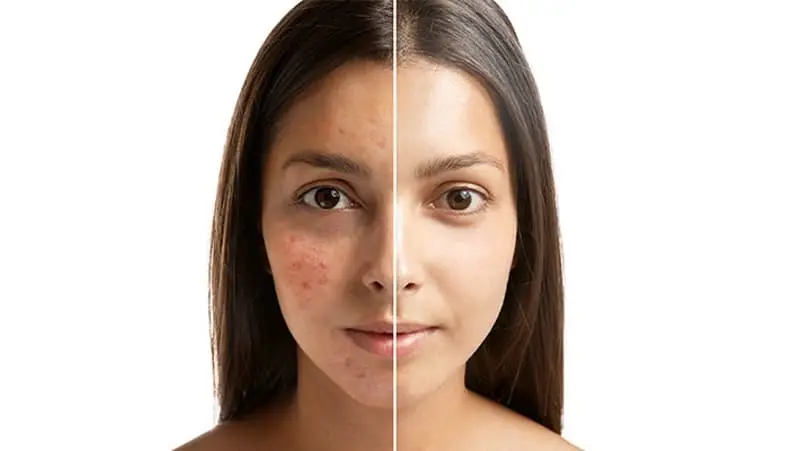
How professional treatments dramatically improve acne scars — real transformation results.
Types Of Acne Scars
Acne scars are not a single entity — they are a category that includes several morphologically distinct wound-healing outcomes, each with its own clinical profile and optimal treatment approach. Getting the classification right before choosing a treatment is essential, because what works well for one scar type may have no effect on another. The three primary atrophic (depressed) scar types are ice pick, boxcar, and rolling scars. Ice pick scars are narrow, deep channels that extend into the dermis and sometimes the subcutaneous fat — they are the hardest to treat because their depth puts them beyond the reach of most surface-level interventions. Boxcar scars have well-defined, angular edges and a flat base; they are shallower than ice pick scars and respond better to resurfacing treatments. Rolling scars have a softer, wave-like appearance caused by fibrous tethering bands beneath the skin that pull the surface downward — a technique called subcision can physically release these tethers before other resurfacing is applied.
Hypertrophic and keloid scars are the less common raised (hypertrophic) type — more prevalent on the chest, shoulders, and jawline than on the central face — and are treated very differently from atrophic scars, typically with corticosteroid injections, laser, or both. Post-inflammatory hyperpigmentation (PIH) is not technically a scar at all but is frequently described as one — it is a flat, discolored mark that forms when active inflammation (from a blemish) triggers excess melanin production. PIH responds well to brightening treatments like chemical peels and topical retinoids and typically fades over time, while true atrophic scarring requires more structural intervention. Chrissy Gray Lim, PA-C, examines the scar morphology of each patient at Auveau under specific lighting conditions before recommending any treatment, because accurate classification drives the entire treatment strategy.
Microneedling For Scars
Microneedling is one of the most well-supported treatments in the medical literature for atrophic acne scarring, particularly for boxcar and rolling scar types. The mechanism is collagen induction: controlled micro-injuries from fine needles stimulate the skin’s natural wound-healing cascade, leading to the production of new collagen fibers in the treated tissue. Over a series of sessions, this new collagen fills in and raises the floor of depressed scars, reducing their depth and smoothing the transition between scarred and unscarred skin. Unlike ablative laser resurfacing, microneedling does not remove the outer skin layer, which makes it safer for patients with deeper skin tones (Fitzpatrick types IV–VI) who carry a higher risk of post-inflammatory hyperpigmentation from more aggressive treatments.
Auveau uses the SkinPen — the first FDA-cleared microneedling device in the United States — which allows precise needle depth adjustment from 0.25 mm to 2.5 mm. Scar treatment typically uses deeper settings (1.5–2.5 mm) than general skin rejuvenation, because the collagen deficiency in scar tissue is deeper in the dermis. Most acne scar protocols involve a series of three to six sessions spaced four weeks apart, with collagen remodeling continuing for up to six months after the final treatment. Results are cumulative — improvement is gradual rather than immediate, which is the expected biology of a collagen-building process. Patients often see the most dramatic difference between sessions two and four, as the newly formed collagen matures and contracts. Chrissy documents each patient’s scar pattern at baseline so progress can be tracked objectively across the series rather than relying on memory or subjective impression.
Chemical Peels
Chemical peels address acne scarring through controlled exfoliation and dermal stimulation, and their effectiveness depends heavily on selecting the right peel depth and acid formulation for the specific scar type and the patient’s skin tone. Superficial peels — glycolic acid at 20–30%, lactic acid, or low-strength salicylic acid — have their greatest impact on post-inflammatory hyperpigmentation (PIH) and surface texture rather than on the structural depth of true atrophic scars. They improve luminosity and even skin tone, which can meaningfully reduce the visible contrast between scar tissue and surrounding skin, and they prime the skin for subsequent treatments. For this reason, a series of superficial peels is often recommended as a precursor to microneedling or laser in a comprehensive acne scar protocol.
Medium-depth peels penetrate into the papillary dermis and provoke a more robust healing response. The VI Peel, which Auveau offers, combines trichloroacetic acid, salicylic acid, phenol, vitamin C, and tretinoin into a single protocol that addresses both pigmentation and early scar remodeling. The VI Peel Precision Plus formulation is specifically indicated for moderate PIH and is well-tolerated across a broad range of Fitzpatrick skin types. Visible peeling typically occurs on days two through five, and most patients are comfortable returning to work within a week. A series of two to four medium-depth peels spaced four to six weeks apart can produce meaningful improvement in scar texture and tone, particularly when combined with a prescription-grade home care regimen. Chrissy Gray Lim, PA-C, selects chemical peel protocols at Auveau based on a thorough assessment of skin type, scar morphology, and the patient’s ability to manage the post-peel healing process — including sun avoidance, which is non-negotiable in the Austin climate.
Laser Resurfacing
Laser treatments represent the highest-efficacy option for moderate to severe atrophic acne scarring, and they operate through a different mechanism than either microneedling or chemical peels. Fractional laser resurfacing — whether ablative or non-ablative — delivers thousands of microscopic columns of thermal energy into the dermis in a grid-like pattern, leaving untreated skin bridges between each column. These bridges contain intact keratinocytes that migrate into the treated columns during healing, dramatically accelerating recovery compared to traditional (non-fractional) full-field ablative lasers. The thermal injury stimulates profound collagen remodeling in the dermis, and the depth of penetration can be adjusted to target the specific depth where atrophic scar deficits exist.
Non-ablative fractional lasers (such as the 1540 or 1927 nm wavelengths) heat the dermis without vaporizing the epidermis, resulting in modest downtime — typically redness and mild swelling for 24 to 72 hours — and are better suited to patients with milder scarring or deeper skin tones. Ablative fractional lasers (CO2 or Er:YAG) remove the outer epidermis within each treatment column and produce more dramatic collagen remodeling, but require five to seven days of healing and carry a higher risk of PIH in darker skin tones if not carefully managed. Patient selection and pre-treatment skin preparation — which typically includes a four-to-six-week course of topical retinoids and, in at-risk skin types, a brightening agent to suppress melanocyte activity — are critical determinants of both safety and outcome. At Auveau, laser protocols for acne scarring are developed with the same rigor as any medical treatment: thorough assessment, appropriate patient selection, and a post-treatment care plan that protects the investment of the procedure. Book a complimentary consultation with Chrissy Gray Lim, PA-C, to receive an honest evaluation of which modality — or combination of modalities — is most likely to produce meaningful improvement for your specific scar presentation.
Why Patients Choose Auveau
With a 5.0-star rating from 233 patient reviews on Google, Auveau has built its reputation on results that look natural and care that feels personal. We are women-owned, LGBTQ+ friendly, and committed to a standard of care that puts your comfort and goals first. Acne scarring is an emotionally significant concern for many patients — one that affects confidence and self-image in ways that extend far beyond aesthetics. Chrissy approaches these conversations with both clinical precision and genuine empathy, because the goal is always meaningful improvement in your quality of life, not just a checkbox on a treatment menu.
Every consultation is complimentary. We believe you deserve honest guidance before committing to any treatment — no pressure, no obligation, just expertise you can trust.
Have a question?
Book a complimentary consultation. We love talking through options.
This article is for informational purposes only and does not constitute medical advice. Individual results may vary. Consult with a qualified provider to determine the best treatment for your needs.